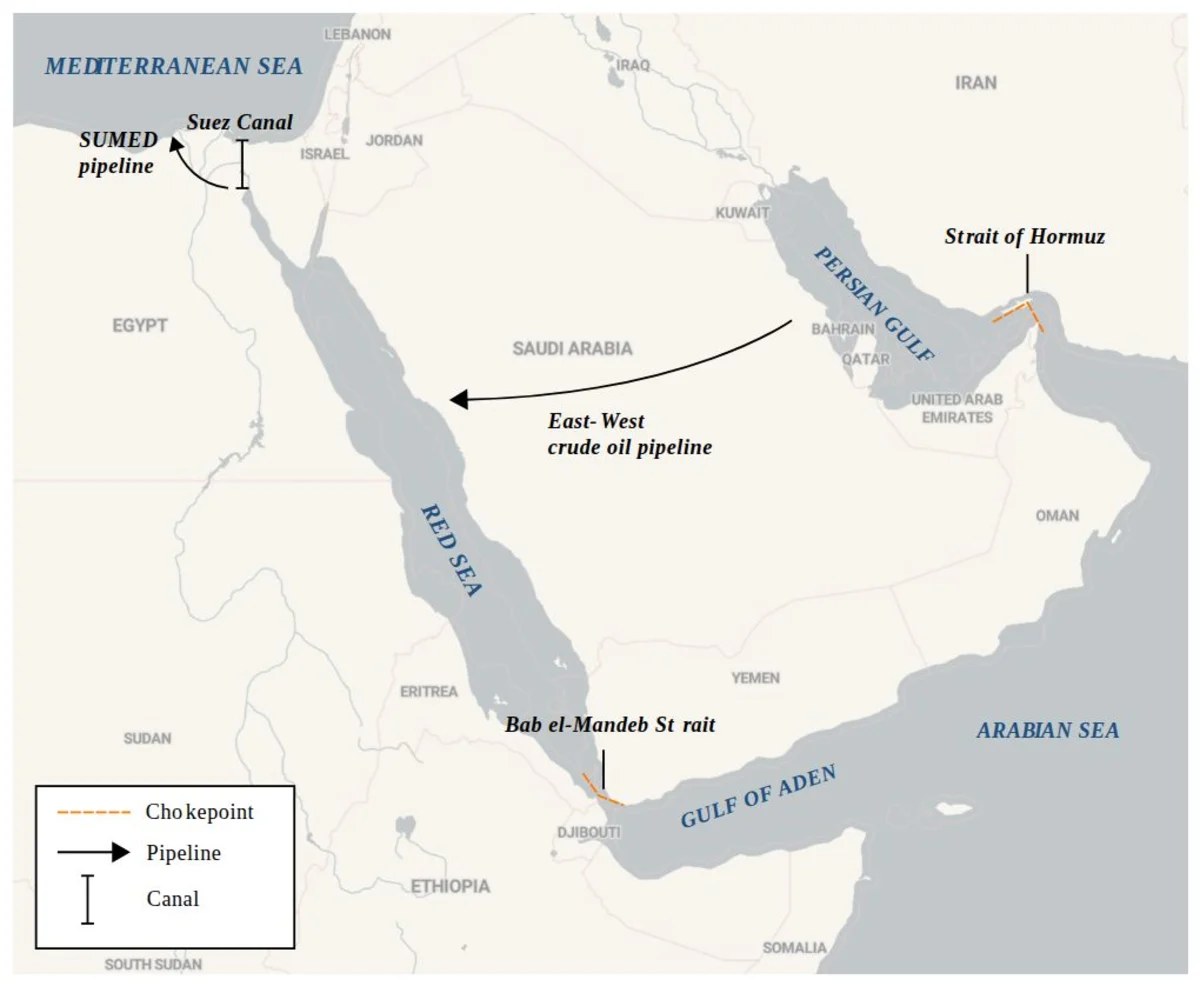
On July 20, Yemen's Houthi rebels declared a naval blockade against Saudi Arabia, widening the front of the US-Iran war. Three days later, strikes on two Saudi tankers in the Red Sea pushed Brent above $100 per barrel for the first time since May, compounding an already acute global oil supply picture.
With the Strait of Hormuz still effectively closed, the Turkish Straits strained by the Russia-Ukraine war, and millions of barrels of oil products dependent on two outlets from the now-threatened Red Sea, more than 30-35% of the world's oil flows are either blocked or at risk of being blocked.
This all makes for a supply crunch that we believe is a compelling investment opportunity for private equity.
Chokepoint bypass infrastructure is an opening for PE
The Red Sea carries oil south into the Indian Ocean through the Bab el-Mandeb Strait and north into the Mediterranean through the Suez Canal and the SUMED pipeline. It's also the outlet for Saudi Arabia's East West Petroline, itself a bypass route. Approximately 4.9 million barrels per day of oil and oil products flow through the Suez Canal/SUMED pipeline, and an estimated 4.2 MMbbl/d transits the Bab el-Mandeb.
Sign up for The Daily Pitch newsletter Subscribe
To bypass future chokepoint risk, Gulf states are accelerating projects to route around Hormuz. The UAE's Abu Dhabi National Oil Company is fast-tracking its west-east pipeline to double export capacity through Fujairah on the Gulf of Oman by 2027. Iraq is advancing a pipeline linking Basra to Haditha with a planned capacity of 2.5 MMbbl/d. Multiple additional projects are reportedly in development to shift a meaningful share of Gulf exports away from Hormuz exposure by 2028.
While oil majors are natural sponsors of this build-out, PE and infrastructure funds are logical partners given capital discipline constraints, in our view. Chevron, which is set to sign an MOU to develop two major oil fields in Iraq, is reportedly partnering with TI Capital and a group owned by the Syrian-Qatari billionaire Al-Khayyat brothers, and advancing discussions to build and revive a pipeline network into Syria to bypass the Strait of Hormuz.
Also notably, Blackstone, KKR and Brookfield agreed to a $16 billion lease-and-leaseback deal for a 49% stake in Kuwait's pipeline network, generating $7.85 billion in upfront proceeds tied to Kuwait Petroleum Corporation's capex plans and its 4 MMbbl/d target by 2035.