IonQ has received final regulatory approval to buy SkyWater Technology, with the $1.8 billion deal expected to close on July 31. You should read it as an industrial commitment, not another quantum promise.
IonQ's SkyWater acquisition has moved out of the regulatory waiting room. On July 28, IonQ said it had received final approval to complete its cash-and-stock purchase of SkyWater Technology, the Bloomington, Minnesota-based semiconductor foundry it agreed to buy in January. The companies expect to close the transaction on Friday, July 31. That is the real news.
The price is still the same $1.8 billion figure IonQ announced in January, with SkyWater shareholders set to receive $15 in cash and $20 in IonQ stock for each SkyWater share, subject to the deal's collar. IonQ has pitched the acquisition as creating the only vertically integrated full-stack quantum platform company. You can roll your eyes at the phrase if you like. The concrete part is that IonQ is buying a U.S. fab, not just signing another manufacturing agreement.
The regulatory path wasn't smooth. In an April 24 SEC filing, IonQ and SkyWater disclosed that the Federal Trade Commission had issued a Hart-Scott-Rodino Second Request, extending the waiting period while the agency reviewed the merger. SkyWater shareholders then approved the agreement at a special meeting on May 8. IonQ's July 28 announcement says the companies have now secured all required regulatory approvals and satisfied other outstanding closing conditions. The public version gives you the result, not the FTC's internal argument.
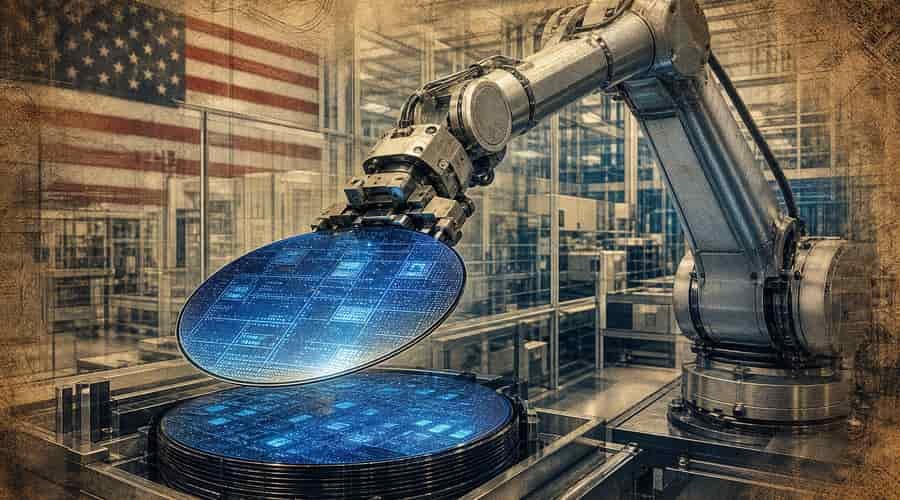
SkyWater is not a generic asset bolted onto a quantum story. The company describes itself as the largest U.S.-based semiconductor foundry, and its Bloomington facility is a DMEA-accredited Category 1A Trusted Foundry. It also has facilities in Florida and Texas. That matters more than the corporate language around the deal, because quantum hardware companies don't scale on slide decks. They need chips, packaging, process control, test cycles and production discipline. The work gets physical quickly.
The U.S. Department of Commerce had already marked SkyWater's Minnesota site as useful infrastructure before IonQ came along. In December 2024, the Commerce Department and SkyWater signed a preliminary memorandum of terms for up to $16 million in proposed CHIPS Act direct funding to modernize the Bloomington facility. The federal summary said the money would support cleanroom upgrades, new equipment and IT infrastructure, and increase 90nm and 130nm wafer capacity by about 30%. Minnesota added a separate $19 million Forward Fund commitment. That is not hype. It is equipment, rooms and wafers.
IonQ also has a more specific technical reason to want control of fabrication. According to the Quantum Computing Report, IonQ has received its first ion trap chip samples back from the fab and is targeting a 256-qubit EQC-based system for 2026. EQC, the electronic qubit control technology IonQ gained through its Oxford Ionics acquisition, replaces laser-based gate operations with microwave and RF fields delivered through a CMOS chip integrated into the ion trap package. You can't spin a foundry. Either the chip comes back and works, or it doesn't.
The harder part starts after closing. SkyWater will operate as a wholly owned IonQ subsidiary under the SkyWater name, but IonQ says it will keep serving a full range of foundry customers. That promise has to hold. Infineon and Quantinuum announced a strategic partnership in November 2024 to develop future ion traps for Quantinuum's quantum computers, and Infineon also works on ion-trap, superconducting and spin quantum pilot lines in Europe. The quantum supply chain is already political. IonQ now owns a U.S. manufacturing option with defense credentials attached.
For startups and investors, this is the useful reality check. Vertical integration sounds tidy until you have to run the factory, protect merchant customer data and still hit your own quantum roadmap - while keeping outside customers from drifting away. Frankly, that is a harder test than another benchmark press release. IonQ's combined company is expected to hold its second quarter earnings call on August 5 after the U.S. market closes, followed by an investor day on September 8. Those dates now carry more weight than usual.
There is a strong case for the deal. IonQ gets domestic fabrication with defense credentials. SkyWater gets a deeper-pocketed owner. And the U.S. government gets a quantum hardware supply chain that is easier to point to than a web of overseas partners. There is also a real execution risk sitting inside the same sentence. If SkyWater remains a credible merchant foundry while accelerating IonQ's own chips, the acquisition will look shrewd. If customers decide an IonQ-owned foundry can't stay neutral, the company will have bought a bottleneck and made it more complicated.
Also read: Zuckerberg bets billions of personal AI agents on Meta's most expensive quarter ever • Manhattan Associates stock surged 27% on July 29 after a blowout Q2 2026 earnings report • Leopold Aschenbrenner's Situational Awareness fund seeks fresh capital after AI selloff hammers its bets