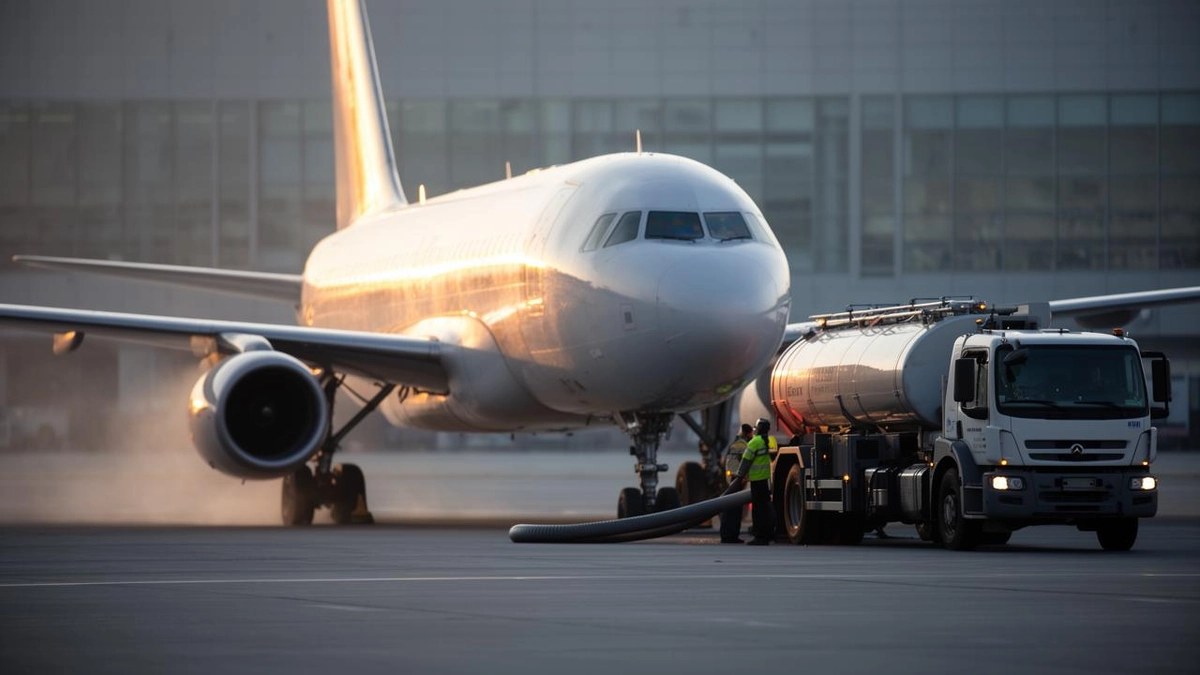
Delta Air Lines (DAL) delivered record third-quarter revenue yet slashed its full-year earnings outlook by nearly a quarter, a stark illustration of how the surge in energy prices since February is overwhelming the carrier's ability to raise fares fast enough to protect profit margins.
The airline now expects adjusted earnings per share of $5.10 to $5.60 for 2026, down from the $6.50 to $7.50 range it projected in July. The midpoint of $5.35 represents a 23.6% cut from the prior midpoint of $7.00 and falls below the $5.46 analysts had been modeling. Free cash flow guidance was also reduced to approximately $2.5 billion, compared with a previous target of $3 billion to $4 billion and last year's actual $4.6 billion.
Shares fell about 4% in premarket trading Friday following the report, reflecting investor concern that the country's most profitable airline is struggling to convert robust demand into earnings growth.
Delta posted GAAP operating revenue of $20.19 billion for the September quarter, up 21% from $16.67 billion a year earlier. After stripping out third-party refinery sales, adjusted revenue came in at $17.59 billion, a 16% increase from the prior-year period and a record for the quarter, though slightly below the $17.67 billion consensus compiled by LSEG.
Adjusted earnings per share were $1.72, missing the $1.75 to $1.76 analysts had expected and marking the first time in two years the airline fell short of profit estimates. GAAP net income dropped 47% to $756 million, or $1.15 per share, from $1.42 billion, or $2.17 per share, a year earlier.
The core problem is straightforward: adjusted fuel expense jumped 62% year over year to roughly $4.1 billion, pushing adjusted operating margin down to 9.4% from 11.1% in the same period last year. Non-fuel unit costs also climbed 7.3%. Adjusted operating income was $1.7 billion, with pre-tax income of $1.5 billion and an 8.5% pre-tax margin.
"Demand remains strong, supported by consumers' growing preference for experiences and travel, with air travel continuing to be one of the best values in the consumer economy," CEO Ed Bastian said.
The squeeze traces back to the war that began in February. Brent crude was trading around $102.91 a barrel and West Texas Intermediate near $90.40 in Asian trading on October 9, up roughly 42% and 35% respectively from pre-war settlement levels. Global jet fuel averaged $187.34 per barrel in the latest International Air Transport Association monitoring, up 1% sequentially.
For the December quarter, Delta projects an all-in fuel price of approximately $4.25 per gallon, about 18% higher than the third quarter, even after accounting for a roughly $0.40 per gallon benefit from its Trainer, Pennsylvania refinery. Management expects roughly $6 billion in incremental fuel costs for the full year.
The structural challenge is timing. Airline tickets are typically sold well in advance, while fuel is purchased and hedged later. When energy prices spike suddenly, carriers cannot reprice seats already sold. Deutsche Bank research suggests the industry's ability to recover new fuel costs through revenue measures may decline in the fourth quarter, with full recovery potentially delayed until early 2027.
"Obviously the fuel pricing, the volatility of fuel prices have something to do with that," Bastian said in an interview, referring to the guidance reduction.
For the December quarter, Delta guided adjusted earnings per share to a range of $1.15 to $1.65, with a midpoint of $1.40. That compares with the $1.42 consensus and represents a decline of roughly 10% from $1.55 a year earlier. Revenue is expected to grow about 20% year over year, with an operating margin of 7% to 9%.
Note: Figures reflect Delta's reported results and guidance. Q3 adjusted revenue excludes third-party refinery sales.
Despite the cost pressure, Delta's revenue mix continues to tilt toward higher-margin segments. Premium revenue grew 18% in the third quarter to $6.82 billion, while main cabin sales rose 12% to $6.8 billion. Loyalty revenue also increased 18%. The airline generated $1.7 billion in operating cash flow during the quarter and $1.9 billion in free cash flow in the first nine months, and it still plans to repay more than $2 billion in debt this year.
Bastian emphasized that fare increases have not dented booking behavior. "The consumer response continues to be quite strong. We're seeing it across all channels, all cabins of service, all geographies, business, leisure," he said.
The latest inflation reading for September showed airfare up more than 23% from a year earlier, evidence that carriers are pushing through price increases even as travelers keep buying.
The fuel shock is reshaping incentives across the aviation supply chain. Higher jet fuel prices amplify the operating cost advantage of next-generation aircraft. Airbus has said the A320neo family reduces per-seat fuel consumption by about 20% compared with the previous generation. As fuel becomes more expensive, the payback period on fleet renewal shortens, strengthening demand for fuel-efficient aircraft and engines.
At the same time, constrained cash flow at airlines may limit purchasing capacity, while aircraft supply shortages and extended service life for older planes benefit maintenance and engine aftermarket businesses. Delta's maintenance revenue grew 28% in the third quarter, supporting that thesis.
IATA's June outlook projected passenger and cargo yields would rise 7% and 6.5% respectively this year, yet industry net profit was still expected to fall to $23 billion from $45 billion last year — a reminder that yield increases driven by cost pass-through do not translate into profit improvement.
For Delta specifically, the path to valuation repair depends on margin stabilization, free cash flow recovery, and an end to downward earnings revisions. The airline continues to target mid-teens margins under its longer-term financial framework and gross leverage approaching one times, but the immediate outlook suggests those goals remain distant while energy prices stay elevated.