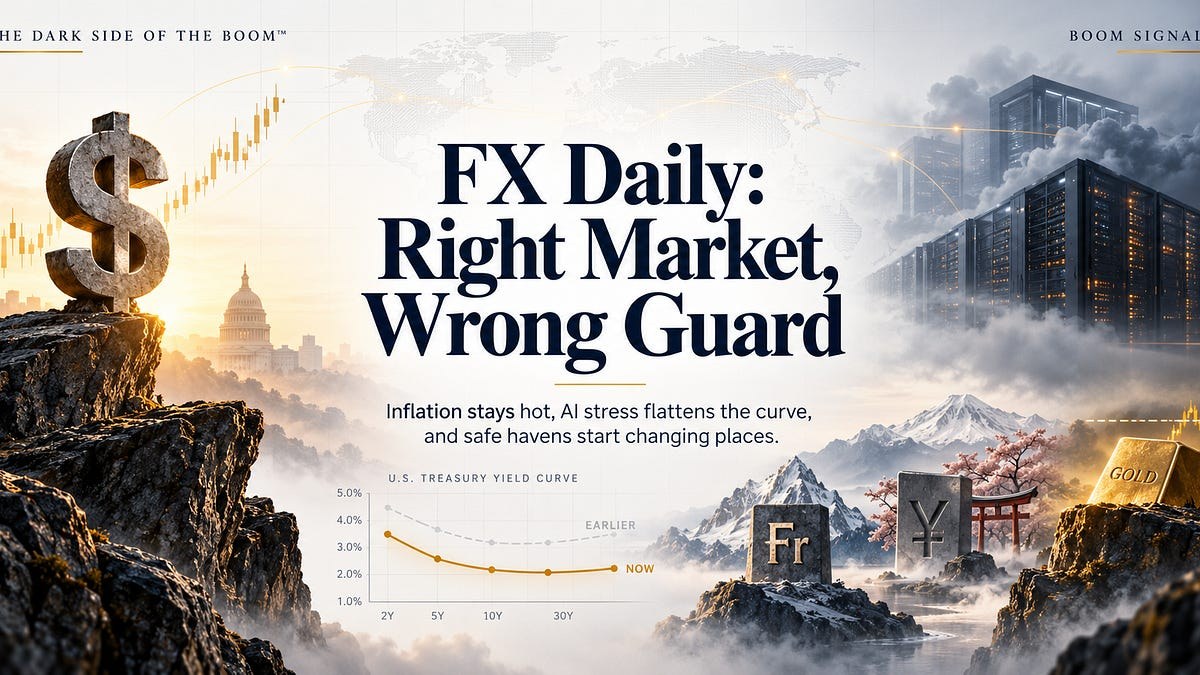
September PPI came in strong, import prices are still running hot enough to keep the inflation story alive, and yet the long end has rallied. The 2s10s curve has flattened by roughly 20bp this week because the short end is still being held up by inflation and the possibility of tighter Fed policy, while the long end is starting to behave like a hedge against weaker growth and a broader correction in the AI trade.
That is a very different setup from the one we were trading last week.
Takeaways by Dark Side of the Boom™
• We read the broad market tension correctly this week, but the change in leadership clipped the payoff as Treasuries reasserted themselves and the dollar refused to break cleanly.
• FX is now caught between two competing stories: inflation is keeping the short end firm while AI overbuild fears are pulling money into the long end and flattening the curve.
• That combination still argues for a resilient dollar against activity and EM currencies, while CHF remains the cleaner defensive winner if the AI correction deepens.
• Gold still looks ripe for a squeeze higher, but sitting roughly $50 below the real ignition point is starting to feel lonelier than comfortable.
Right Market, Wrong Guard
It has been one of those weeks where we got the market right only to discover that the market had quietly changed who was carrying the flag.
The broad call was not wrong. We caught the EUR/USD faceplant as inflation stayed hot, but we were slower to react to the way AI financing stress was pulling the old safe-haven complex back into the foreground. By the time we realised the FX winds had shifted, the changing of the guard was already underway and that clipped the payoff. Treasuries had started behaving like Treasuries again, the franc was becoming the cleaner defensive bid, the yen had found its footing, and the dollar was no longer the only shelter in town just as the original call was finally paying us.
We were looking for the right inflation storm , but the FX wind changed direction while we were standing in it.
The more interesting FX question now is what this flatter Treasury curve is actually telling us.
The CoreWeave scare eased after the latest reassurance around its financial position, and that was enough to take some heat out of the immediate AI panic. But the bigger takeaway from the week is not that one stock bounced. It is that long-dated Treasuries have finally started attracting proper demand again even while the inflation data remain hot.
The bond market is effectively saying two things at once: inflation is still too hot for the Fed to relax, but the economy and the market may not be strong enough to absorb endless tightening without something cracking.
FX usually likes that sort of contradiction because it forces the market to choose which side of the story matters more.
For now, the dollar still has an argument.
If the Fed keeps the brakes on while growth expectations soften, the dollar normally does well against the more activity-sensitive currencies and against EM. The short end has not broken lower, and that is the key. Until front-end rates really start collapsing, it is hard to build a convincing case for a sustained dollar selloff.
That is why I still think the dollar is more likely to consolidate near recent highs than roll over completely.
The difference now is that the safe-haven hierarchy is no longer one-dimensional.
If the next shock comes through AI credit rather than inflation, the Swiss franc probably has the cleaner path to outperformance because it does not need to win a yield contest to perform. A market that starts buying duration, marking down growth and reducing risk is exactly the sort of environment where CHF can quietly start doing the heavy lifting.
That makes USD/CHF more interesting to me than simply trying to force a large EUR/USD move out of the same story.
The dollar index probably struggles to get much traction above 102.40/50 from here unless the inflation side of the argument wins decisively again. Support around 101.75/80 is still the first area that matters, and as long as that holds the dollar remains more in consolidation than reversal.
That is the difference between a pause and a turn.
September eurozone CPI is expected to be confirmed at 3.8%, which leaves the ECB with inflation sitting well above target and a market already pricing a lot of tightening. The interesting part is that EUR/USD has benefited from the unease around US AI stocks, not because Europe suddenly looks attractive, but because the dollar side of the equation has softened just enough to let the pair breathe.
That can carry EUR/USD toward 1.1340/50 if the corrective phase in the dollar has legs, but I would still be careful about treating the euro as the cleanest defensive expression of a broader US equity wobble.
The French bond story remains unresolved, the ECB still has its own inflation headache, and Europe does not suddenly become a haven just because Silicon Valley catches a cold.
That is why the franc still looks cleaner.
The broader setup is now one of those awkward trader environments where the macro story is obvious but the cross-asset expression is shifting under your feet. Inflation is still too hot to let the front end collapse. AI credit stress is enough to make the long end interesting. The dollar is still supported by rates but no longer owns every risk-off bid. Gold still looks poised for a squeeze, but the market is making anyone waiting for the ignition point pay rent.
Not a full return to the old world where yen, franc and Treasuries absorb every shock while the dollar folds agains havens. Not yet.
But enough of a change to remind us that being right on the macro and wrong on the expression can still make for a frustrating week.
Gold is another example. I still think the market is ripe for a squeeze higher because the ingredients have not disappeared: fiscal concerns remain front and centre, AI credit is starting to wobble, and the market is increasingly willing to hedge against something more awkward than a simple growth slowdown. But sitting roughly $50 south of the real kick-in point is starting to feel lonely. The thesis may still be right, but the market has not yet agreed to pay us for being early.
For now, I am treating this as a consolidation phase rather than a regime break. The dollar has probably done enough on the upside for the moment, CHF remains the cleaner defensive trade if AI stress deepens, EUR/USD can continue to repair without becoming the star of the show, and gold is still sitting close enough to the fuse that I am not ready to walk away from the squeeze.
The uncomfortable part is simply that the fuse has not been lit yet, and $50 south of the ignition point is a long way to sit when the market has decided to change the guard before changing the trend.