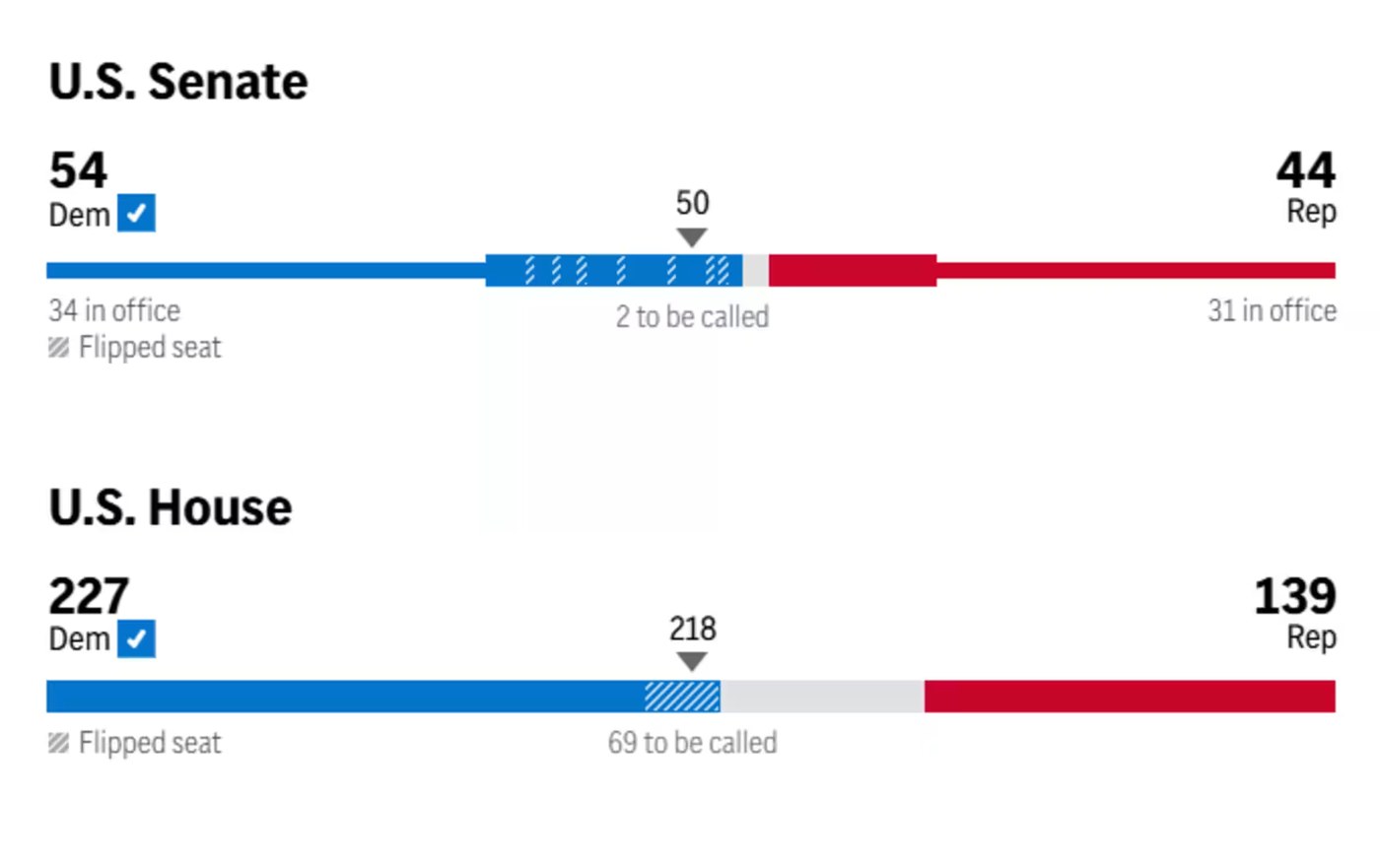
WASHINGTON/NEW YORK -- The opposition Democratic Party has won control of the U.S. Senate and House of Representatives, according to media projections, capitalizing on widespread voter discontent over Republican President Donald Trump's policies on inflation, tariffs, AI data centers and the Iran war.
In the weeks leading up to the Nov. 3 midterm elections, forecasters overwhelmingly favored the Democrats to take back the House, while the battle to regain control of the Senate was expected to be much closer.
However, only hours after polls closed, Democrats flipped Republican Senate seats in North Carolina, South Carolina, Ohio, Texas, Kansas and Iowa, according to the Associated Press, clearing the key 51-seat threshold in the 100-seat chamber. The AP called the House for the Democrats later in the night, after the party surpassed 218 seats. In 2024 and 2022, the AP did not call control of the House until eight days after Election Day.
Readers can follow Nikkei Asia's live coverage and analysis of the midterm elections at asia.nikkei.com.
Follow the latest updates below (Washington time):
2:40 a.m. Democrat Abdul El-Sayed has won his Senate race in Michigan, defeating Republican Mike Rogers, according to the Associated Press and other outlets, which note that he is the first Muslim elected to the chamber.
2:15 a.m. A Chinese foreign ministry spokesperson says the midterm results are an internal affair of the U.S., but that Beijing is willing to strengthen communication with Washington.
1:35 a.m. Democrats have won the House as well, according to the Associated Press, securing control of both chambers of Congress. This leaves Trump facing a daunting final two years of his presidency. On Truth Social earlier, he posted a picture of a red hat emblazoned with the word "VETO," presumably implying how he intends to handle legislation that crosses his desk.
1:10 a.m. Trump has acknowledged the results but deflected blame for Republican losses. In an interview with Fox News -- which he blasted on Truth Social on election night for "constantly and consistently putting on the Dumocrat opposition" -- the president said the Democrats "did a good job" and "fought hard."
"I don't view it as a hit on me," he said. "We've had the greatest two years in the history of the presidency."
In another Truth Social post, Trump stressed that he "wasn't on the Ballot" and that if he had been, Republicans "would have won IN A LANDSLIDE!"
1:05 a.m. In another closely watched Senate race, Democrat Troy Jackson has defeated Republican incumbent Susan Collins in Maine, according to the Associated Press.
11:20 p.m. Trump's glowing endorsement of Republican Sen. John Husted and his physical appearance did not help the incumbent retain his seat in Ohio.
Democrat Sherrod Brown took the key seat in a state that has shifted right in recent years and voted for Trump in three consecutive presidential elections, the Associated Press called at 11:10 p.m.
11:10 p.m. The hotly contested Senate campaign in Texas ended up being a walkover as Democrat James Talarico handily defeated Ken Paxton, a Republican handpicked by Trump and backed by Elon Musk.
It is the first time the Democrats have won a statewide office in the state since 1994, according to the Associated Press, which called the race at 11:03 p.m.
Talarico's win is the third of four seats the Democrats need to flip -- without losing any seats they are defending -- in order to gain a majority in the Senate.
10:40 p.m. Pediatrician Annie Andrews unseated Republican Darline Graham, giving Democrats another Senate pickup, this time in South Carolina.
Graham was appointed to the seat after her brother, Sen. Lindsey Graham, died in July. She then decided to run for the seat herself amid questions about her experience.
The result gives Democrats the second of the gains they need to take control of the Senate.
Control of the chamber would give Democrats a wide range of oversight powers, including the ability to subpoena testimony and conduct impeachment trials.
8:40 p.m. The Democrats flipped their first Senate seat. Democrat Roy Cooper won North Carolina's open seat in the chamber, defeating Trump-backed Republican Michael Whatley, the Associated Press projected at 8:23 p.m. The seat was open after Republican Sen. Thom Tillis decided not to seek reelection.
Cooper, a former governor and state attorney general, delivered Democrats their first Republican-held Senate seat of the night. They need to flip three more Republican seats to take control of the Senate.
8:15 p.m. Georgia Democrat Jon Ossoff won reelection to the Senate, defeating Republican Mike Collins, a two-term congressman endorsed by Trump in the party primary. The Associated Press called the race at 7:55 p.m.
Ossoff, a sharp Trump critic who has been mentioned as a potential 2028 presidential candidate, was the only Democratic senator seeking reelection in a state Trump won in 2024. Holding the seat was considered crucial to Democrats' hopes of taking control of the Senate.
7 p.m. Democratic Sen. Mark Warner won reelection in Virginia, the Associated Press called as polls closed in the state. Warner, vice chairman of the Senate Intelligence Committee, defeated Republican Bert Mizusawa, a retired Army major general, to secure a fourth term. The race had been rated "solidly Democrat" by the Cook Political Report.
Polls also began closing at 7 p.m. in Georgia, South Carolina, Vermont and most of Florida.
6 p.m. Polling centers in parts of Indiana and Kentucky have closed, the first in the nation to do so. Because both states straddle the Eastern and Central time zones, some of their polls will close an hour from now. Anyone in line by 6 p.m. will be allowed to vote.
The Senate seat up for grabs in Kentucky, a state that overwhelmingly backed Trump in the 2024 election, is expected to remain in Republican Party hands, according to analysis by the Cook Political Report.
4:30 p.m. U.S. stocks were mixed on Tuesday as investors awaited the outcome of the midterm elections, prompting largely position-adjusting trades. Shares related to artificial intelligence rebounded, while some cyclical and defensive stocks came under pressure.
The S&P 500 rose 0.4%, while the tech-heavy Nasdaq composite gained 0.8%. The Dow Jones Industrial Average, meanwhile, fell 0.4%.
Lower oil prices provided some support for investor sentiment amid hopes for progress toward ending the U.S.-Iran conflict. President Donald Trump told Fox News on Tuesday that U.S. funding support for Israel, which assisted in attacks on Iran, would be halted "by the end of this year," reinforcing expectations that Washington could be moving toward diplomacy with Tehran.
3:50 p.m. Asian countries are bracing for a renewed trade offensive after the U.S. midterm elections, with the Trump administration expected to use executive powers to impose tariffs regardless of which party controls Congress.
Nomura economists, including Ruchir Sharma, expect "more aggressive trade-related headlines" after the elections, including possible tariffs stemming from Section 301 investigations into excess capacity. Nikkei Asia previously reported that Trump held off announcing the tariffs, including a 7.5% rate on Chinese imports, amid concerns about inflation ahead of the vote.
The duties would come on top of existing 10% to 12.5% tariffs imposed on about 60 economies over alleged forced-labor practices. Combined, the measures would effectively restore tariff rates for several key trading partners to levels seen before the Supreme Court in February struck down Trump's sweeping tariffs under the International Emergency Economic Powers Act.
For China, that would stoke renewed tensions between Beijing and Washington in the next two years, says Hui Shan, chief China economist at Goldman Sachs, adding a Congress with greater Democratic control may introduce new hawkish measures on China.
2:45 p.m. Asian Americans and Pacific Islanders, one of the fastest-growing groups of U.S. voters, have traditionally leaned Democratic but shifted toward Republicans in the 2024 presidential election.
But their trust in Republicans has declined since Trump returned to the White House, survey results released in October by AAPI Data show. AAPI adults, previously divided over which party they trusted more on the economy and immigration, clearly favor Democrats on both.
Karthick Ramakrishnan, founder of AAPI Data, said Trump campaigned on the economy and immigration during the 2024 presidential election.
"On both of those things, he hasn't delivered," Ramakrishnan said. "In early 2025 we saw Democrats and Republicans as essentially tied on the economy and on immigration, and now we've seen a huge swing away from the Republican Party."
Disapproval of Trump's handling of the economy and foreign policy has also risen among AAPI adults since January of this year, with the biggest shift among Republicans. About 40% of AAPI Republicans disapprove of his handling of both, up from about 20%.
David Chan, a 42-year-old consultant in New York City, said he voted for Democrats. He said economic policies and contributions to the Asian American community were deciding factors, adding that his expectations for major policy support for the community remain low.
1:10 p.m. The U.S. Justice Department said on Tuesday it is deploying about 1,000 election monitors and observers across all 50 states, the largest effort in its history and the first to cover every state.
The department's Civil Rights Division is coordinating the deployment, as monitors check compliance with federal voting rights laws and officials remain in contact with state and local election authorities throughout election day. The department has deployed election monitors since the Voting Rights Act was enacted in 1965.
Some state election officials and civil groups have raised concerns about the sharp increase in monitors and the potential for voter intimidation or other interference, local media reports show.
Trump has repeatedly blamed voting "fraud" for his 2020 presidential election loss and sought greater federal oversight of elections, which are administered by state and local officials. Those efforts have been blocked by the courts.
11:55 a.m. Early voting surged ahead of election day, with 59.1 million in-person and mail-in ballots cast nationwide, the University of Florida's Election Lab reports. That is more than half the total ballots cast in the 2022 midterms.
The number of ballots cast via early voting in Colorado, Florida, Georgia, Montana, Nevada, North Carolina, Oregon and Tennessee was equivalent to more than 70% of each state's total 2022 turnout.
By party registration, Democrats accounted for 43% of early ballots and Republicans 31.4%, though registration does not indicate how voters cast their ballots.
The numbers may appear favorable to Democrats, but Republicans historically have been more likely to vote on election day and have less confidence than Democrats that mail-in ballots will be counted, Pew Research reports.
11 a.m. Heavy rain and flooding have forced some polling centers in Florida to relocate, with eight counties affected. Gov. Ron DeSantis issued an executive order on Monday to establish temporary voting centers "to ensure that residents in those areas in affected counties still have the ability to vote."
Flash flooding in the West also has affected Arizona, Utah and Colorado. Utah's lieutenant governor on Monday issued a "declaration of emergency election accommodation," allowing affected voters to request electronic ballots.
Rain and gusty conditions in parts of the Midwest and "strong to severe storms" in eastern Texas also were raising concerns about access to polling centers on Tuesday morning.
Historically, bad weather has suppressed voter turnout on election day.
10:45 a.m. Oil prices rebounded early Tuesday after reports of a fresh U.S. strike on Iran's Qeshm Island in the Strait of Hormuz renewed supply concerns on election day.
January Brent crude futures rose 1.8% to $106.63 a barrel, while U.S. West Texas Intermediate gained 2.4% to $97.08, reversing some of Monday's sharp losses. The strikes tempered hopes for a diplomatic breakthrough, though President Donald Trump said a peace agreement with Tehran "could still happen."
Higher energy costs are hitting Asian economies unevenly. China and India have been cushioned by domestic coal reserves, while Thailand, the Philippines and South Korea remain more exposed because of their reliance on energy imports, according to ING analysts.
Japan is expected to begin phasing out gasoline subsidies in December after reinstating them in the spring. The U.S. Energy Information Administration forecasts Brent will average $105 a barrel in the fourth quarter before falling to $84 in 2027 as regional logistics adjust.
10:05 a.m. Artificial intelligence has emerged as an unexpected flashpoint in the elections. Widespread local opposition to digital infrastructure is shaping campaigns in both the Democratic and Republican parties, even prompting allegations that China is fueling anti-data center sentiment.
Voters across the political spectrum are opposing data centers due to the heavy energy demands, fears of higher electricity rates and the way hyperscalers have pursued development. The issue has become prominent enough that moratoriums have made it onto ballots. One state to watch is Ohio, where data center development has accelerated and the world's largest AI data center is planned. Senate candidates from both parties are campaigning against the infrastructure or linking their opponents to its potential negative impacts.
Whatever the election outcome, growing resistance to data centers could have implications for suppliers, many of which are based in Asia.
9 a.m. Polls have opened for the 2026 midterm elections, widely seen as a referendum on President Donald Trump's agenda. Polling station hours vary by state and sometimes even within a state, so results will be reported this evening in staggered waves.
This election has prompted a surge in early voting, particularly in states with close Senate races. In South Carolina, early voting was up more than 80% from the previous midterms in 2022, The Associated Press reports, while the figure was 50% for Texas and 44% for Maine.
Top issues for voters include inflation and rising energy costs linked to the Iran war, trade tariffs and backlash against artificial intelligence data center projects.
Issues related to China, meanwhile, faded from campaign rhetoric.